Porto universities record some of Portugal’s highest first-round admission rates
More than 8,000 students secured places across degree programmes at Porto’s two public higher education institutions, which recorded some of Portugal’s highest vacancy fill rates in the first phase of the National Higher Education Admissions Competition.
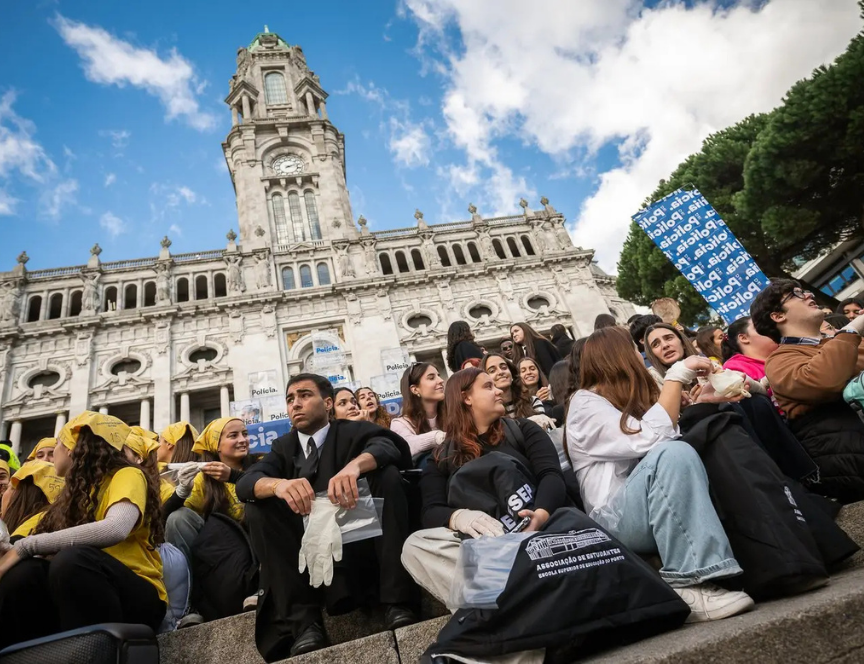
The University of Porto topped the national ranking, with 99.1 per cent of available places filled in the first round. The Porto Polytechnic Institute, now the Technical University of Porto, recorded the second-highest fill rate among polytechnic institutions, at 98.9 per cent.
Several University of Porto programmes also recorded some of the country’s highest entry grades. The Bachelor’s degree in Aerospace Engineering at the Faculty of Engineering once again stood out, recording the highest entry grade of any degree programme in Portugal for the third consecutive year. The last of the 30 admitted students had an average grade of 19.5 out of 20.
The Integrated Master’s degree in Medicine at the Faculty of Medicine, with an entry average of 18.7, and the Bachelor’s degree in Industrial Engineering and Management, also with an entry average of 18.7, were the university’s other programmes among those with the highest entry grades nationwide.
The University of Porto also retained its position as the Portuguese public university with the highest average entry grade, at 16.3 out of 20.
Only 53 places remained unfilled at the University of Porto, across the Bachelor’s degrees in Chemistry, Geology, Geospatial Engineering, Environmental Science and Technology, and Agricultural Engineering.
At the Technical University of Porto, all available places were filled. The Bachelor’s degree in Industrial Management recorded the highest entry average, at 18.1, followed by Management, at 17.8.
Porto Mayor Pedro Duarte welcomed the results, saying they reflected the presence of centres of "excellence”, the "strength of the institutions” and their ability to "attract a great deal of talent”.
But the Mayor said attracting students and graduates must go hand in hand with improving employment opportunities in the city.
"We need to create better-quality jobs in the city, with higher salaries and more opportunities and better prospects for young people,” the Mayor said.
For the Mayor, the university sector is "fundamental” to achieving that goal. He highlighted work being carried out by the municipality and the city’s universities to create opportunities for young people graduating in Porto to remain in the city and build their careers there.
Among the initiatives he highlighted was PITCH, a platform designed to bring together the municipality and academia and help develop an innovation ecosystem. The Mayor described it as a project capable of generating "a new economy in the city”.
The Mayor also pointed to the Porto Economic and Business District (DEEP), which the municipality aims to develop as a major incubator for technology-based companies.
Housing, however, remains a major concern for students. The Mayor acknowledged that the supply of university residences "has grown considerably”, but said privately operated accommodation remained too expensive for many families.
The municipality is working with the new University of Porto rectorate to identify additional solutions. The Mayor said the city must also look beyond its central area, given the size of its student population.
"We are aware that, in the city centre, it will be very difficult to accommodate the tens of thousands of young people who attend higher education,” the Mayor said.
The Mayor therefore argued that it was "very important” to work with neighbouring municipalities closest to the university area and able to provide additional student accommodation options.
The approach, he suggested, would extend Porto’s higher education network beyond the city’s administrative boundaries, giving students more accommodation options while helping the city retain the talent attracted by its universities.